Most answers to this question give you a number of hours and stop there. The number is useful, and we will give it to you. But two people can put in exactly the same hours and end up years apart, because what decides your progress is not only the time you spend in lessons. It is what happens in between.
The short answer
The Foreign Service Institute, which has trained American diplomats for decades, places French in its easiest group of languages for English speakers, alongside Spanish and Italian. Its estimate for professional working proficiency is around 600 to 750 hours of class time.
For most people, though, professional proficiency is not the goal. Holding a real conversation at a dinner table, understanding the person at the market, explaining what you think without freezing: that is usually B1 or B2 on the European scale, and it is reachable in roughly 350 to 600 hours.
Spread those hours over thirty minutes a day and you are looking at two to three years. Spread them over two hours a week with nothing in between and it takes considerably longer. The hours matter, but the rhythm matters more, and the sections below explain why.
What “learning French” actually means: the six levels
Before counting hours, it helps to know what you are counting towards. The Common European Framework describes six levels, from A1 to C2. Here is what each one lets you do, and the hours usually associated with reaching it.
| Level | What you can do | Cumulative hours |
|---|---|---|
| A1 | Introduce yourself, order, ask simple questions, understand someone speaking slowly and clearly to you. | 60 to 100 |
| A2 | Handle everyday exchanges: shopping, directions, talking about your family, your work, your plans for the day. | 160 to 200 |
| B1 | Hold a conversation on familiar subjects, cope on your own while travelling, tell a story, give a simple opinion. | 350 to 400 |
| B2 | Talk with ease and spontaneity, defend a point of view, follow a news programme, work in French. | 500 to 600 |
| C1 | Express yourself fluently without searching for words, pick up humour and implication, handle demanding subjects. | 700 to 800 |
| C2 | Operate in French as you do in your own language, with all the nuance that implies. | 1,000 and above |
These figures are widely used orders of magnitude, not guarantees. They assume regular practice between lessons, which is exactly the variable most learners underestimate.
Why the hours between your lessons decide everything
Imagine two people who both take one ninety-minute lesson a week. The first closes her book at the end of the lesson and opens it again seven days later. The second listens to a French radio programme while cooking, messages a friend in French, and reads a few paragraphs of news before bed.
On paper they are doing the same course. In practice the second is putting in three or four times the exposure, and the gap shows within a few months. This is the part that hour counts never capture, and it is the single best predictor of how fast someone progresses.
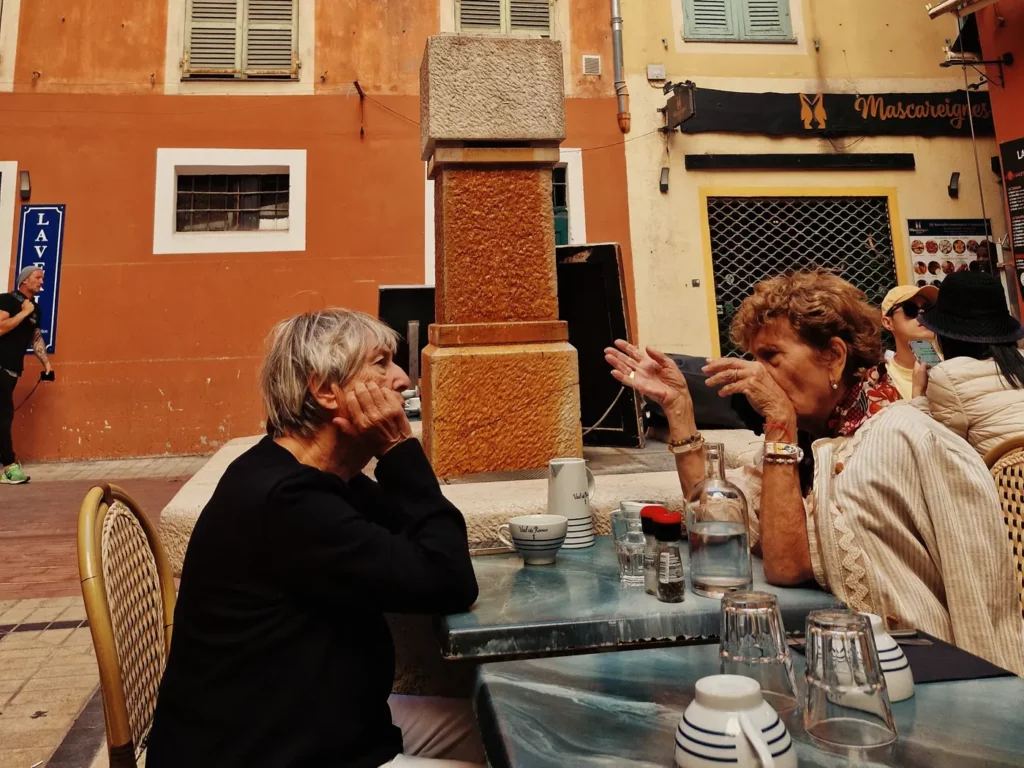
It also explains something that frustrates a lot of learners: understanding improves much faster than speaking. Listening and reading can be done alone. Speaking cannot. If your weekly total contains no conversation at all, your passive French will keep growing while your spoken French stays where it is.
Five factors that change your timeline
The language you already speak
French shares a great deal of vocabulary with English, largely thanks to the Norman conquest: nation, important, restaurant, impossible. Speakers of Spanish, Italian or Portuguese have an even bigger advantage, since the grammar itself is familiar territory. That head start is real, and it is usually worth several months.
The time you actually have, week after week
Thirty minutes every day beats three hours every other Sunday. Regularity is what builds reflexes, and reflexes are what make a conversation possible. Be honest about the time you can protect, and build around that rather than around an ideal schedule you will abandon in March.
Where you are starting from
School French from twenty years ago is not nothing. It is often a solid foundation buried under a lack of practice, and it comes back much faster than it was first learnt. Many people who describe themselves as complete beginners are in fact rusty A2s.
Whether you are willing to speak badly for a while
This is the factor nobody lists, and it slows more learners down than any grammar rule. Waiting until your French is correct before using it means never using it. The people who progress fastest are the ones who accept sounding clumsy for a few months.
The method, and the mix
An app builds vocabulary. A lesson builds structure and corrects what you cannot hear yourself. Conversation turns both into something you can actually use. Each does one job, and relying on only one of the three is what produces the plateau most learners hit.
Your age is not the factor you think it is
The idea that adults cannot learn languages comes from a misreading: children do reach a native accent more easily, but adults learn faster in almost every other respect. You already understand how grammar works, you can study deliberately, you know what you want to say, and you have reasons to keep going that no eight-year-old has.
What actually varies between learners is available time, regularity, and how comfortable they are speaking imperfectly. A busy thirty-year-old with no free evenings often progresses more slowly than a retired sixty-five-year-old with mornings to spare. Age is a poor predictor. Rhythm is a good one.
What a week of immersion actually changes
An immersion stay does two things at once, and only one of them is about lesson hours.
The first is arithmetic. A six-day stay at Azur Immersion includes fifteen hours of lessons, five sessions of three hours, plus two hours of preparatory video call before you arrive. The ten-hour online package, taken at the usual rate of one lesson a week, spreads over roughly two months. A single week on site is one and a half times that volume, condensed.
| Format | Lesson hours | Over what period |
|---|---|---|
| Online lesson package | 10 hours | around 2 months, at one lesson a week |
| Weekend stay (3 days) | 6 hours | one weekend |
| Week stay (6 days) | 15 hours | six days |
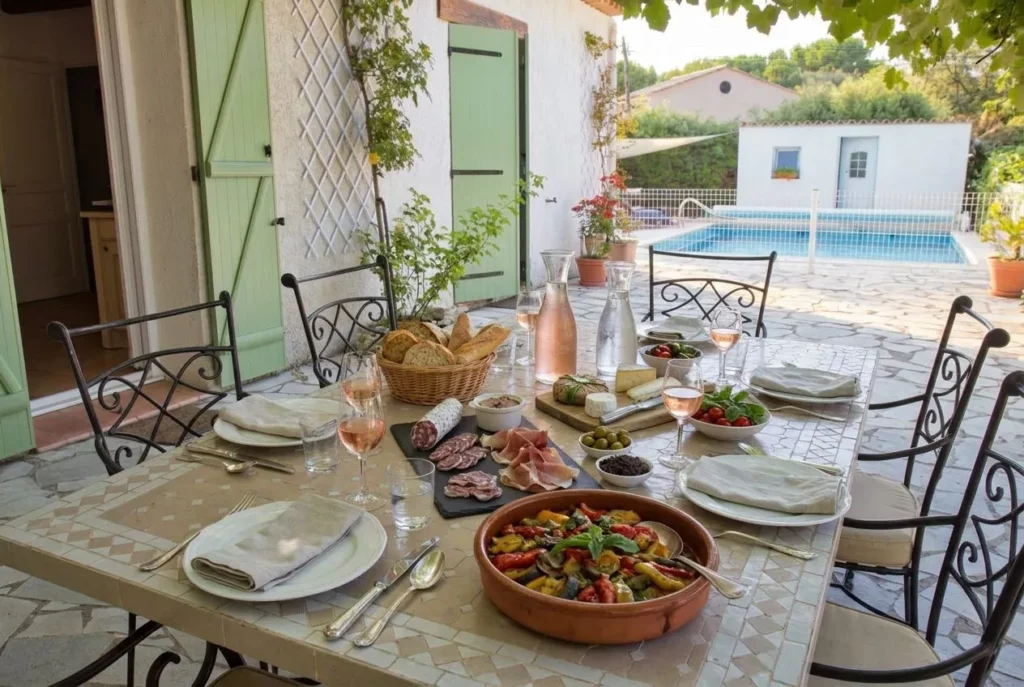
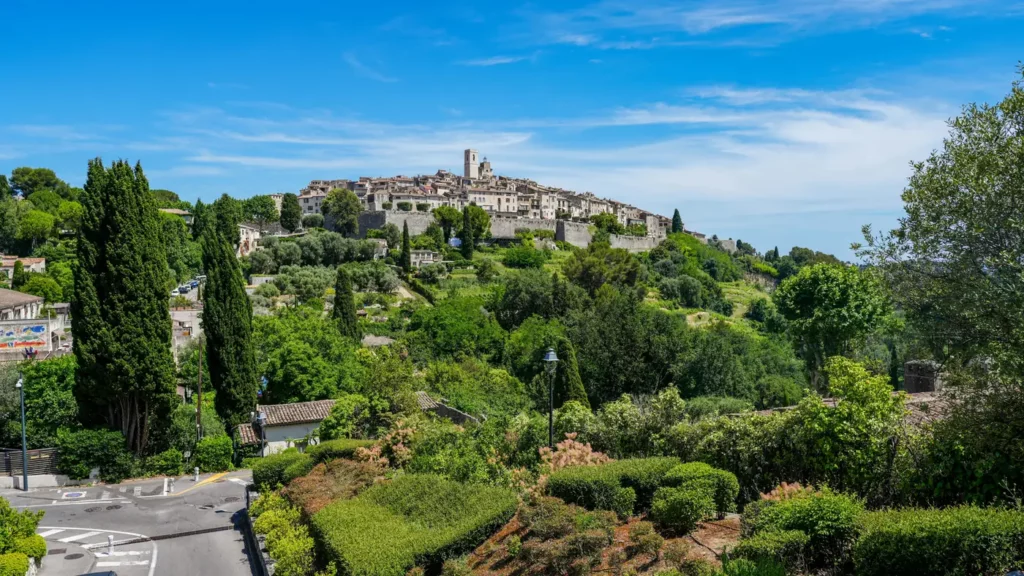
The second thing is the part that does not appear in any table, and it is the more important one. Lessons run in the morning, from nine to twelve. The rest of the day is Provence: lunch on the terrace, an afternoon at a vineyard or in a hilltop village, dinner with Marie and Alain. None of that is homework. You are not studying for eight hours a day, you are having lunch, and the lunch happens to be in French.
That is the mechanism behind our immersion method: the hours between the lessons stop being a gap you have to fill with discipline, and become the part of the day you look forward to. A day of French immersion in Provence describes what that actually looks like, hour by hour.
It also compresses something that usually takes months: the move from understanding French to speaking it. When the only way to ask for the salt is in French, the sentence comes out. Repeat that for six days, with someone who corrects you gently rather than letting it pass, and the reflex settles in.
What slows most learners down
Relying on an app alone. Apps are good at vocabulary and terrible at conversation. Fifteen minutes a day for a year builds a reasonable passive vocabulary and almost no ability to speak.
Studying without ever speaking. It is the most common pattern and the most frustrating one, because the effort is real and the result does not show where the learner wants it to.
Stopping and restarting. Three months on, three months off, repeated over two years, produces far less than eighteen consecutive months at half the intensity.
Waiting to be ready. There is no threshold beyond which you are allowed to speak French. The threshold is the decision to start.
Frequently asked questions
Can you learn French in three months?
You can reach A1 and the beginnings of A2 in three months of serious daily work, which means introducing yourself, ordering, asking for what you need and following a simple conversation. You will not be fluent, and anyone promising fluency in three months is selling something. But three months is enough to stop feeling helpless, which is what most people actually want first.
Is French hard to learn for English speakers?
It is among the easier languages for an English speaker, by the FSI’s own classification. The vocabulary overlap is large. The genuine difficulties are pronunciation, especially nasal vowels and the French r, spelling that rarely matches what you hear, and grammatical gender. None of them is a wall, and all of them respond to hearing the language spoken rather than reading about it.
Am I too old to learn French?
No. Adults learn languages efficiently, and the research on this is consistent: what declines with age is the ease of acquiring a native accent, not the ability to learn a language. An accent is not a problem, it is a detail. What matters is whether you have time each week and whether you are willing to speak before you are perfect, and neither of those depends on your date of birth.
How many hours a week should I aim for?
Five hours a week, split across several days, is a rhythm most people can sustain and it produces visible progress. One structured lesson, and the rest spread across listening, reading and, above all, conversation. Two hours done every week beat six hours done once a month.
Is Duolingo enough on its own?
It is a good way to build vocabulary and keep a daily habit, and it is a poor way to learn to speak, because it never asks you to hold a real exchange with someone who might answer something unexpected. Use it alongside lessons and conversation, not instead of them.
From counting hours to actually speaking
There is no shortcut that removes the hours. There is, however, a large difference between hours that accumulate slowly in isolation and hours that come with conversation, correction and a reason to keep going. Online French lessons with Marie are the simplest way to start from home, and the article on going from online lessons to an immersion stay explains how the two fit together. When you want the calendar to move faster, a stay in Fayence, thirty minutes from Cannes, is what compresses it. Have a look at the stay packages and rates, or contact Marie: she replies personally within 24 to 48 hours, and the first conversation costs nothing.